Falcon Heavy | Nancy Grace Roman Space Telescope
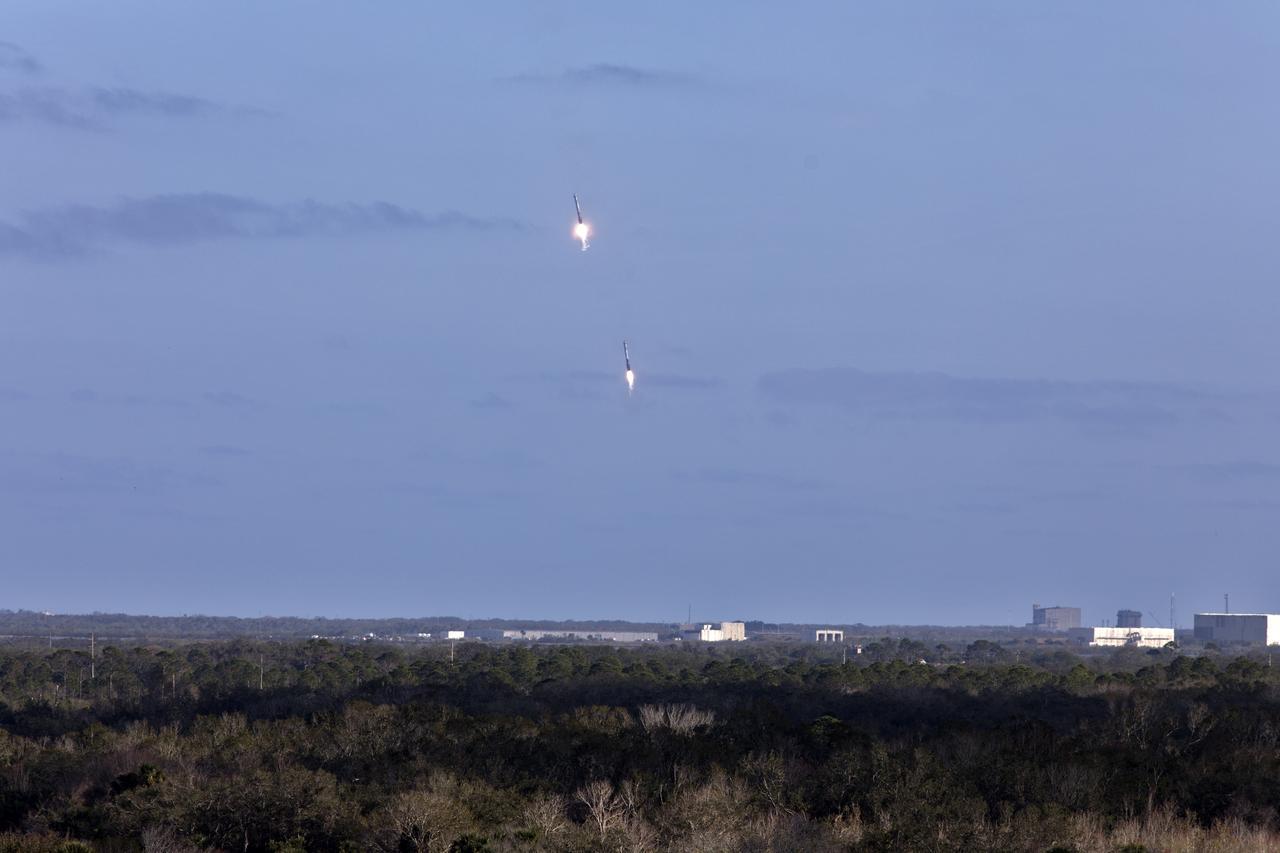
SpaceX launched Falcon Heavy carrying Nancy Grace Roman Space Telescope from Launch Complex 39A, Kennedy Space Center, FL, USA, United States of America on August 30, 2026 at 11:26 UTC. The launch was a success.
COUNTDOWN
FLIGHT PLAN
The window opened at 2026-08-30 11:25:49Z and closed at 2026-08-30 11:26:19Z. The launch vehicle successfully inserted its payload(s) into the target orbit(s).
FIELD KIT / OPTICS
Where to start if you want a telescope for the back garden.
As an Amazon Associate I earn from qualifying purchases. Buying through these links doesn't cost you anything extra.
- VIEW
LISTING
Celestron Travel Scope 70 mm Refractor
A 70 mm scope on a light tripod that packs into its own backpack, so it's easy to take out. It shows craters on the Moon, Jupiter's four bright moons and the shape of Saturn's rings. The tripod is the weak part, so expect to steady it.
- BROWSE
SEARCH
Beginner Dobsonians
A big mirror on a simple rocker mount, with no motors to go wrong. This is a search, not one pick. Compare 130 mm and 150 mm models before you buy.
- BROWSE
SEARCH
Beginner refractors
Lighter and quicker to set up than a Dobsonian, but weaker on faint galaxies and nebulae. Worth a look if the scope has to live in a cupboard.
BROWSE opens an Amazon search. It isn't a pick of one product.
LINKS AMAZON.COM
MISSION BRIEF
The Nancy Grace Roman Space Telescope is a NASA infrared space telescope with a 2.4 m (7.9 ft) wide field of view primary mirror and two scientific instruments. The Wide-Field Instrument (WFI) is a 300.8-megapixel multi-band visible and near-infrared camera, providing a sharpness of images comparable to that achieved by the Hubble Space Telescope over a 0.28 square degree field of view, 100 times larger than imaging cameras on the Hubble. The Coronagraphic Instrument (CGI) is a high-contrast, small field of view camera and spectrometer covering visible and near-infrared wavelengths using novel starlight-suppression technology. Roman objectives include a search for extra-solar planets using gravitational microlensing, and probing the expansion history of the Universe and the growth of cosmic structure, with the goal of measuring the effects of dark energy, the consistency of general relativity, and the curvature of spacetime.
SOURCE: LAUNCH LIBRARY 2 // THE SPACE DEVS
LAUNCH CORRIDOR
- Due east
- The lowest inclination a direct launch from here can reach is 28.6°. That’s this pad’s own latitude. Flying east also gets the most free speed from Earth’s rotation.
- Due south
- The polar corridor, at 90° inclination, passes over both poles. It gets no help from Earth’s spin, so the same rocket can carry less.
Drag the globe to turn it. The shading is the real terminator, and it moves.
A globe of the Earth centred on Launch Complex 39A at latitude 28.61 degrees north, longitude 80.60 degrees west. Two curved lines leave the pad. The solid gold line runs due east and marks the lowest orbital inclination a direct launch from this site can reach, 28.6 degrees, equal to the pad’s latitude of 28.6 degrees. The dashed cyan line runs due south and marks the polar corridor at 90 degrees inclination. The darkened part of the globe is the night side. The surface wind is from 83° at 37 km/h. That's the cyan arrow at the pad.
LAUNCH SITE
Launch Complex 39A
Kennedy Space Center, FL, USA, United States of America
OBSERVED 2026-11-19 21:30:00Z // OPEN-METEO (CC BY 4.0) // GENERAL CONDITIONS, NOT LAUNCH CRITERIA
Minimum direct inclination 29°. This pad is 29° north of the equator, so a direct launch can't reach an orbit inclined less than 29°. An orbit of inclination i never passes over latitudes beyond ±i. Getting to an equatorial orbit, which geostationary satellites need, takes a 29° plane change at some point in the flight. Inclinations of 29° and up are reachable straight off the pad. The ground here moves east at about 408 m/s with Earth's spin. That's 465 m/s at the equator, falling with the cosine of latitude. A launch due east keeps that head start.
DATUM WGS-84 // EQUIRECTANGULAR PROJECTION // ORBIT FIGURES DERIVED FROM THE PUBLISHED LATITUDE
Open this pad in a mapPAD CONDITIONS
SURFACE WIND @ 10 M
37km/h
Blowing from the east, bearing 83 degrees
GUSTING
55km/h
Overcast
SOURCE: OPEN-METEO CC BY 4.0
The observed figures are general weather at the coordinates of Launch Complex 39A. They aren’t the launch rules. The operator and the range write those for each mission, and they cover things this forecast doesn’t carry, like electric fields, cloud layers higher up and winds along the rocket’s path. Only the operator publishes them. Wind often stops a countdown, but no number here is a limit for this flight. Nothing here is a go or no-go call. No operator figure was published for this attempt.